
We offer you 100% custom-made service Inquiry

For safety, quality, security, use Kaydeli!
For safety, quality, security, use Kaydeli!
In integrated hydrogen production and refueling stations, the hydrogen production process requires adjustable cooling water from 7°C to 30°C, while hydrogen pre-cooling requires cryogenic chilled water at -50°C. Traditionally, this involves two separate units, which not only occupies space but also significantly increases costs for operation coordination and subsequent maintenance. KEDLE integrates a ambient temperature industrial chiller with a cascade cryogenic chiller into a single dual-condition unit, providing two temperature zones from a single rack, with explosion-proof and protection levels meeting stringent on-site requirements. This article reconstructs the entire process of this project, from selection to implementation, providing a reference for similar scenarios.
The project site is a typical integrated hydrogen production and refueling station. The hydrogen production area uses an alkaline water electrolysis process, producing 100 standard cubic meters of hydrogen per hour. The electrolyzer generates a large amount of heat during operation, requiring a stable cooling water system to control the temperature within the process requirements. The refueling area is equipped with a diaphragm compressor and a hydrogen dispenser. Hydrogen needs to be pre-cooled to extremely low temperatures before filling to ensure refueling speed and safety. There is no separate utility building within the station; all auxiliary equipment is centrally located in the transition area between two explosion-proof zones, resulting in limited available installation space. The client faces a practical challenge: the hydrogen production process requires cooling water, and hydrogen pre-cooling requires chilled water. Using two separate units would be impractical due to space constraints, and the separate procurement, installation, and maintenance of each unit would double the cost and management complexity.
The client's core requirement is clear: to integrate the two cooling sources into a single unit, simultaneously outputting ambient temperature cooling water and -50°C chilled water, with independent control and no interference between the two systems. Furthermore, all electrical components must meet Zone I explosion-proof requirements, with an explosion-proof rating of T4 or higher.
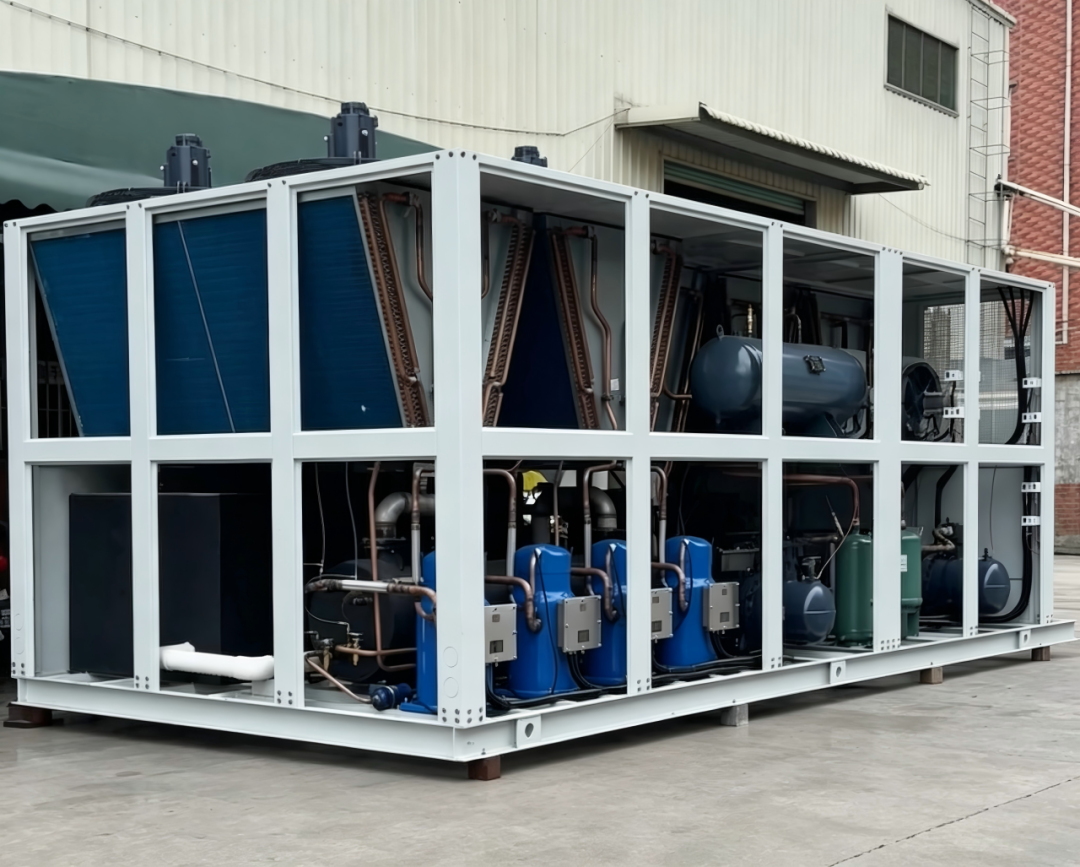
Within the housing of a single unit, two independent water circuit systems with a temperature difference exceeding 80°C are housed—a condition unthinkable for traditional standard refrigeration equipment. Through preliminary technical communication and understanding of the operating conditions, Kaydeli tailored a dual-condition, high-temperature-difference chiller unit specifically for this hydrogen energy company. Physically, it's a single integrated unit, internally containing two independent water system loops, sharing a structural base and control system. The refrigerant and secondary refrigerant loops operate independently.
(Factory Test Site) Kaydeli Ambient Temperature Cooling Water System
The system employs a parallel configuration of multiple scroll compressors, using R410A refrigerant, coupled with a high-efficiency finned condenser and plate evaporator. Actual test data shows that the cooling capacity reaches 250kW at 7℃ outlet water and 12℃ return water, exceeding the customer's requirement of 240kW, with sufficient safety margin. The outlet water temperature can be continuously adjusted within the range of 7-30℃ to meet the differentiated needs of different stages of the hydrogen production process.
The system uses a cascade refrigeration cycle: the high-temperature stage uses R404a refrigerant, and the low-temperature stage uses R23 refrigerant. Heat transfer between the two stages is completed through a plate condenser-evaporator. The condenser uses a high-efficiency finned structure with sufficient cooling airflow to ensure that the condensing pressure does not exceed the standard under high-temperature conditions in summer. The evaporator is a plate-type high-efficiency heat exchanger, specifically optimized for Glacier LM-8 refrigerant to prevent excessively high refrigerant viscosity at low temperatures from affecting heat exchange efficiency.
The entire unit employs a fully intelligent temperature control system with a fully Chinese LCD display interface. Two water systems are independently controlled; operators can set the cooling water outlet temperature and chilled water outlet temperature separately via touchscreen, and the system automatically adjusts the compressor's operating status.
Regarding explosion-proof compliance, the compressor motor is an Ex eb IIC T4 explosion-proof motor. All wiring terminals, circuit breakers, and relays in the control cabinet are products with Zone I explosion-proof certification. Key components such as temperature sensors and pressure transmitters are equipped with separate explosion-proof enclosures. The entire unit meets on-site requirements through compliance coverage of all electrical components.
Quantified Value: A 40% reduction in footprint. This zero-failure equipment has been operating for over 12 months at the customer's integrated hydrogen production and refueling station, withstanding summer temperatures of 38°C and winter temperatures of -5°C. 01 Cooling Water System Performance: When the electrolyzer load fluctuates significantly, the outlet water temperature remains stable within ±0.5℃ of the set value. The compressor automatically starts and stops according to the load, resulting in significant energy savings under partial load conditions. Actual measurement shows a cooling capacity of 250kW at 7℃ outlet water, exceeding customer requirements and providing ample margin for process fluctuations. The evaporator shows no signs of corrosion after long-term operation in ethylene glycol solution, and the water tank volume meets on-site buffering requirements. 02 Chilled Water System Performance: The outlet water temperature is stably controlled within ±0.5℃ of the set value, and it takes approximately 18 minutes to reach -50℃ from startup. The cascade system works well, and the low-temperature stage compressor discharge temperature remains below the limit even under the highest summer load. After optimization for Glacier refrigerant LM-8, the plate evaporator's pressure drop is within the expected range, the magnetic pump operates with stable current, and there are no leaks. The water tank and the station's buffer tank are well-matched, and cooling loss is controlled within acceptable limits. 03 Overall Unit Performance: The customer operated the unit at full load for 72 consecutive hours without any alarms or shutdowns. The fully Chinese touchscreen interface is intuitive; on-site operators can independently complete parameter settings and operating mode switching after only 30 minutes of training. Since its operation, there has not been a single interruption in hydrogen production or refueling due to cooling source issues.
The Kaydeli dual-condition large temperature difference chiller unit essentially integrates a normal temperature chiller and a cascade ultra-low temperature chiller into a single rack. While this sounds simple, truly achieving independent temperature control and non-interference between two independent refrigeration systems, two water systems, and two control logics tests system integration capabilities and manufacturing precision.
By continuing to use the site you agree to our privacy policy Terms and Conditions.